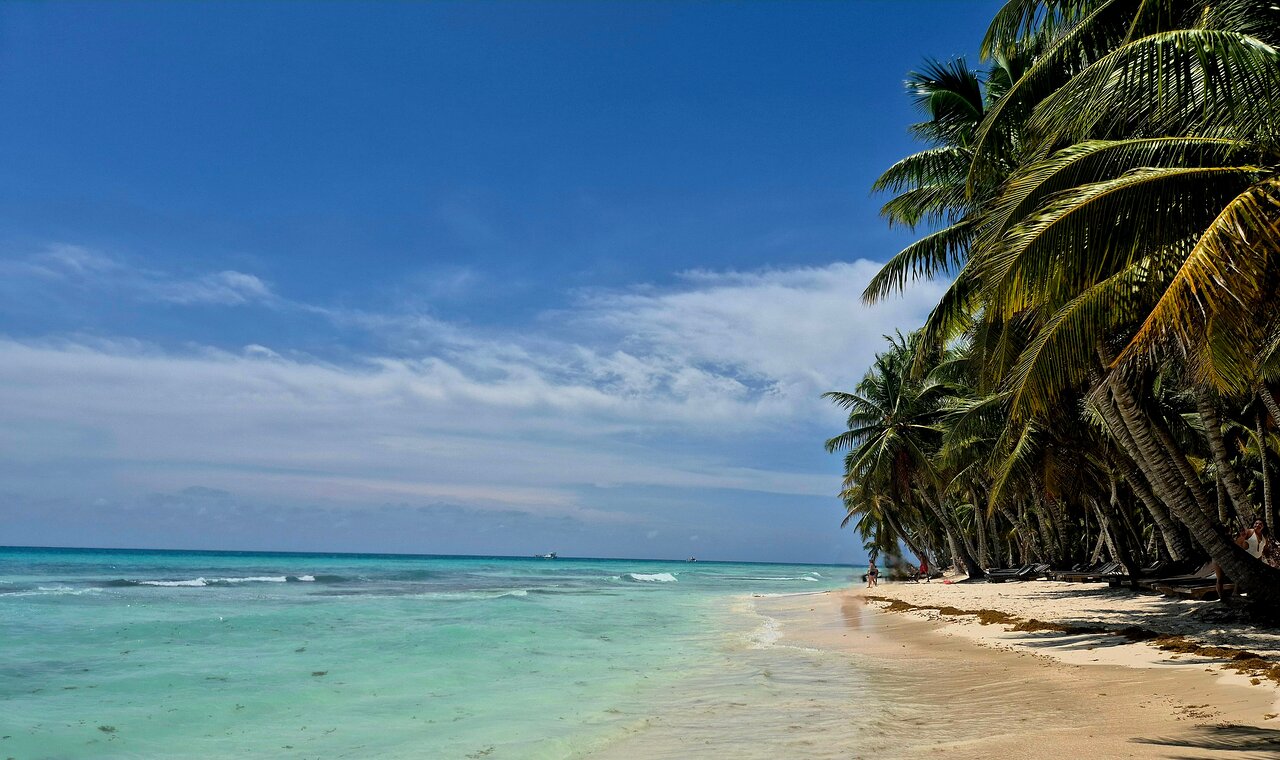
Saona Island Underwater Light: Ocean Colors, Water Clarity and Marine Optical Science
The clear turquoise water surrounding tropical islands is one of the most recognizable features of Caribbean coastal scenery. Visitors often admire the bright blue sea, colorful underwater landscapes and sunlight shining through shallow water.
But why does seawater look blue in some places, turquoise in others and green or brown under different conditions?
The answer lies in the science of underwater light.
When sunlight enters the ocean, it interacts with water molecules, suspended particles, dissolved substances and marine organisms. Some wavelengths are absorbed, others are scattered, and the remaining light determines the colors and brightness that people observe.
This field of study is known as marine optics or ocean optical science.
Around Saona Island in the Dominican Republic, understanding underwater light provides an interesting way to explore coastal environments, water clarity, marine photography and the relationship between sunlight and underwater habitats.
This guide explains how light travels through seawater, why ocean colors change, what influences visibility and how scientists measure the optical properties of marine environments.
1. What Is Underwater Light?
Underwater light is sunlight that enters the water and travels through the ocean.
Sunlight contains a range of visible wavelengths that people perceive as different colors.
These colors include:
- Violet.
- Blue.
- Green.
- Yellow.
- Orange.
- Red.
When sunlight reaches the sea surface, some light is reflected back into the atmosphere. The remaining portion enters the water and begins interacting with the aquatic environment.
As light travels through seawater, its intensity and color composition change.
The amount of light available underwater depends on several factors, including:
- Sunlight intensity.
- Water depth.
- Water clarity.
- Suspended particles.
- Dissolved organic substances.
- Surface conditions.
- The optical properties of seawater.
These factors influence the appearance of underwater environments and the amount of sunlight available to photosynthetic organisms.
2. Why Does the Ocean Look Blue?
One of the most common questions about marine environments is why the ocean often appears blue.
A major reason is the selective absorption of light by water.
Longer visible wavelengths, especially red and orange, are absorbed more strongly than shorter blue wavelengths.
As light travels through a sufficient thickness of relatively clear water, much of the red light disappears. Blue wavelengths remain more prominent in the light that is scattered back toward an observer.
This contributes to the blue appearance of many ocean environments.
The sky can also contribute reflected light at the sea surface, but ocean color is not simply a reflection of the sky. Water itself has important optical properties that influence its appearance.
The exact color depends on the interaction between water, light, particles and dissolved substances.
3. Light Absorption in Seawater
Absorption occurs when a substance takes in light energy rather than allowing it to continue traveling through the water.
Different substances absorb different wavelengths with different strengths.
Pure water strongly absorbs red and near-infrared light, while blue wavelengths can travel farther under suitable conditions.
Marine optical scientists study absorption because it helps explain:
- Why underwater colors change with depth.
- Why clear ocean water often appears blue.
- How dissolved substances influence water color.
- How much light remains available for photosynthesis.
- Why visibility varies between marine environments.
Absorption also occurs because of substances within seawater, including phytoplankton pigments and colored dissolved organic matter.
These materials can change the amount and color of light available underwater.
4. Light Scattering in the Ocean
Scattering occurs when light changes direction after interacting with particles, molecules or other structures in water.
Instead of traveling along a single straight path, scattered light moves in different directions.
Scattering can be influenced by:
- Suspended sediment.
- Organic particles.
- Phytoplankton cells.
- Small particles produced by biological activity.
- Water molecules.
- Bubbles created by waves and turbulence.
The quantity, size and composition of particles influence the scattering process.
For example, water containing many suspended particles may scatter more light and appear cloudy or less transparent.
Scattering is one reason that coastal water can look different from clear offshore water.
5. Why Does Caribbean Water Sometimes Look Turquoise?
Shallow tropical coastal water often appears turquoise or bright blue-green.
Several optical processes contribute to this appearance.
Shallow Water Depth
In shallow areas, sunlight can travel to the seabed and reflect from sand, coral material or other bottom surfaces.
The reflected light then travels back through the water and reaches an observer.
Light Absorption
Water absorbs different wavelengths at different rates, changing the color composition of light as it travels.
Seabed Reflection
Bright sandy bottoms can increase the amount of light returning from shallow water.
Suspended Particles
Fine particles and biological material can change how light is scattered and absorbed.
Viewing Conditions
Sun angle, cloud cover, surface waves and viewing direction also influence the appearance of coastal water.
The combination of these processes can produce the bright turquoise colors commonly associated with tropical island scenery.
6. How Suspended Sediment Changes Water Color
Sediment can strongly influence the optical properties of coastal water.
Particles may enter the marine environment through natural erosion, runoff, wave action and the movement of seabed material.
When suspended sediment concentrations increase, water may become less transparent.
Depending on the particle characteristics and environmental conditions, the water may appear:
- Pale blue.
- Greenish.
- Gray.
- Yellow-brown.
- Muddy or cloudy.
The optical response depends on particle size, mineral composition, concentration and the surrounding water conditions.
This is why water color alone cannot provide a complete measurement of sediment concentration or environmental quality.
Scientific measurements are necessary to distinguish between different causes of changing water appearance.
7. The Influence of Phytoplankton on Ocean Color
Phytoplankton are microscopic photosynthetic organisms that live in marine and freshwater environments.
They contain pigments, including chlorophyll, that absorb certain wavelengths of sunlight.
These pigments influence the color of water.
When phytoplankton concentrations are relatively high, their pigments and the particles themselves can change the amount of light absorbed and scattered.
Some phytoplankton-rich waters appear greener than waters containing fewer phytoplankton.
Scientists use ocean color observations to estimate chlorophyll concentrations and investigate biological productivity.
However, coastal waters contain multiple optical materials, so interpreting satellite color measurements can be more complicated than it is in clearer open-ocean environments.
8. Colored Dissolved Organic Matter
Another important component of ocean optics is colored dissolved organic matter, often abbreviated as CDOM.
CDOM consists of dissolved organic compounds that absorb light, particularly in the ultraviolet and blue parts of the spectrum.
These substances may originate from:
- Decomposition of plants.
- Organic material transported from land.
- Marine biological activity.
- Breakdown of other organic compounds.
CDOM can influence water color and reduce the penetration of certain wavelengths.
In some environments, high concentrations of colored dissolved organic matter contribute to yellowish, brownish or darker water appearances.
Scientists study CDOM because it provides information about organic material in aquatic environments and helps explain differences in optical conditions.
9. What Is Water Clarity?
Water clarity describes how easily light can pass through water without being strongly absorbed or scattered.
Clear water generally allows greater visibility and deeper light penetration than water containing large amounts of suspended material.
However, water clarity and water quality are not exactly the same thing.
A water body can look clear while containing substances that require laboratory testing to detect.
Likewise, naturally productive coastal water may appear green or slightly cloudy without necessarily indicating pollution.
Water clarity is influenced by:
- Suspended sediment.
- Phytoplankton.
- Dissolved organic substances.
- Water movement.
- Biological particles.
- Bottom disturbance.
For marine researchers, measuring clarity is one useful component of environmental monitoring.
10. Light Attenuation and the Kd490 Measurement
As light travels deeper into water, its intensity generally decreases.
This reduction is called light attenuation.
Scientists often describe the decrease in underwater light using a diffuse attenuation coefficient.
One commonly used measurement is Kd490, which describes the attenuation of light around a wavelength of 490 nanometers in the blue-green part of the visible spectrum.
Kd490 is useful in ocean-color research because it provides information about how quickly light intensity decreases with depth.
In simplified terms:
- A lower Kd490 value generally indicates clearer water and deeper light penetration.
- A higher Kd490 value generally indicates stronger light attenuation and reduced clarity.
Researchers use this measurement in water-quality studies and satellite-based ocean monitoring.
It is important to interpret Kd490 with appropriate data and methods rather than treating it as a complete measure of all aspects of water quality.
11. How Underwater Light Supports Marine Photosynthesis
Sunlight provides the energy needed for photosynthesis.
In marine environments, photosynthetic organisms include:
- Seagrasses.
- Macroalgae.
- Phytoplankton.
- Photosynthetic microorganisms.
These organisms use light energy to convert carbon dioxide and water into organic compounds.
The amount and quality of available light can influence photosynthetic activity.
When suspended particles, dissolved substances or strong water-column attenuation reduce light penetration, photosynthetic organisms may receive less usable light.
For seagrass meadows, sufficient light is especially important because the plants depend on underwater sunlight to maintain growth.
Light conditions therefore form an important connection between ocean optics and coastal ecosystem health.
12. Underwater Light and Coral Reef Environments
Coral reef environments contain complex biological communities that depend on interactions between sunlight, water movement and living organisms.
Many reef-building corals contain symbiotic algae that require light for photosynthesis.
The optical conditions around a reef can influence how much sunlight reaches these organisms.
Factors such as turbidity, suspended sediment and dissolved organic material may reduce light availability.
However, coral reef health is influenced by many environmental conditions, including temperature, water chemistry, pollution and biological interactions.
Underwater light is one important factor rather than a complete explanation of reef condition.
13. Why Underwater Visibility Changes
Snorkelers and divers may notice that underwater visibility changes between different locations or even at the same location on different days.
Possible reasons include:
Rainfall and Runoff
Heavy rainfall can transport sediment and organic material from land into coastal waters.
Wave Activity
Strong waves can disturb seabed sediment and increase suspended particles.
Currents
Water movement can transport particles and replace local water with water having different optical characteristics.
Biological Activity
Changes in phytoplankton and other microorganisms can influence the optical properties of water.
Weather and Sunlight
Cloud cover and changing sunlight angles influence the amount of light entering the sea.
Depth and Seabed Conditions
The distance light travels through water and the reflectivity of the seabed influence underwater brightness and visibility.
These factors explain why a single observation cannot represent water clarity throughout an entire island or coastline.
14. How Scientists Measure Underwater Light
Marine researchers use several instruments to study underwater optical conditions.
Secchi Disk
A Secchi disk is a circular disk lowered into water until it is no longer visible.
The depth at which it disappears provides a simple estimate of water transparency.
It is commonly used in aquatic monitoring, although the results depend on lighting, observer conditions and water characteristics.
Underwater Light Sensors
Light sensors measure the amount of light at different depths.
Researchers can compare surface and underwater measurements to understand how quickly light decreases.
Spectroradiometers
These instruments measure light across different wavelengths.
They help scientists investigate the spectral characteristics of underwater light and water-leaving radiation.
Turbidity Meters
Turbidity instruments measure light scattering associated with suspended particles.
They provide useful information about the cloudiness of water, although turbidity is not identical to every aspect of optical clarity.
Satellite Ocean-Color Sensors
Satellites measure light leaving the ocean surface.
Scientists use these observations to estimate parameters such as chlorophyll concentration, suspended particulate matter and light attenuation.
Coastal measurements require careful interpretation because shallow seabeds, land adjacency and mixed water constituents can influence satellite signals.
15. Ocean Color and Satellite Monitoring
Satellite ocean-color technology allows scientists to observe large marine regions repeatedly.
Instruments on satellites detect visible light reflected or scattered from the ocean surface.
These observations can help researchers estimate:
- Chlorophyll concentration.
- Suspended particulate matter.
- Water color.
- Light attenuation.
- Broad patterns of biological productivity.
Satellite monitoring is valuable because it covers areas that would be difficult to measure continuously using boats alone.
However, satellite observations are not direct measurements of every condition beneath the surface.
Clouds, atmospheric effects, shallow seabed reflectance and complex coastal water composition can affect interpretation.
For Saona Island, satellite ocean-color products may provide regional context, but local field measurements are necessary to confirm conditions at specific beaches, reefs or coastal locations.
16. Underwater Light and Marine Photography
Light is one of the most important factors in underwater photography.
As sunlight travels through water, colors change because different wavelengths are absorbed at different rates.
Red and orange tones are often reduced more quickly than blue tones.
This can make underwater photographs appear predominantly blue or green.
Photographers can improve their results by considering:
- Shooting in suitable natural lighting.
- Staying relatively close to the subject.
- Avoiding unnecessary disturbance of seabed sediment.
- Using appropriate underwater lighting where permitted.
- Adjusting white balance carefully.
- Maintaining safe distances from marine animals.
- Following local photography and protected-area rules.
Good underwater photography depends on both technical choices and responsible interaction with marine habitats.
17. Human Activities and Coastal Optical Conditions
Human activities can influence water clarity and optical conditions.
Potential sources of change include:
- Poorly managed construction runoff.
- Coastal erosion.
- Untreated wastewater.
- Agricultural runoff.
- Dredging and seabed disturbance.
- Excessive sediment entering coastal waters.
- Marine pollution.
These activities may increase suspended particles or alter the amount of dissolved material in seawater.
Reduced light penetration can affect photosynthetic habitats such as seagrass meadows and some coral reef environments.
Responsible coastal development, erosion management and wastewater treatment help protect marine water quality.
18. Climate Change and Underwater Light
Climate change can influence underwater optical conditions through several pathways.
Changes in rainfall can affect runoff and sediment transport.
Changes in storm frequency or intensity may influence seabed disturbance and coastal erosion.
Warming can alter biological productivity and the distribution of marine organisms, which may affect the optical properties of seawater.
These effects are not identical everywhere.
Understanding long-term changes requires repeated measurements of water clarity, suspended material, ocean color and other environmental variables.
19. Responsible Marine Tourism Around Saona Island
Visitors can help protect coastal environments by reducing activities that disturb sediment or introduce pollutants.
Responsible practices include:
- Avoid standing on or damaging coral structures.
- Do not disturb seagrass beds.
- Avoid throwing rubbish into the water.
- Follow designated swimming and snorkeling guidance.
- Use responsible boat operators.
- Avoid unnecessary seabed contact.
- Respect protected marine habitats.
- Follow local conservation instructions.
Clear-looking water is not a reason to ignore environmental protection. Even sensitive habitats beneath apparently calm and transparent water require care.
20. Why Marine Optical Science Matters
Understanding underwater light provides valuable information about marine ecosystems.
Marine optical science helps researchers:
- Investigate water clarity.
- Monitor suspended sediment.
- Study phytoplankton and chlorophyll.
- Estimate light availability for photosynthesis.
- Understand underwater visibility.
- Observe broad coastal environmental changes.
- Support marine habitat monitoring.
For Saona Island, optical studies could help researchers understand differences between shallow sandy areas, seagrass environments and other coastal habitats.
Such conclusions should be based on local measurements rather than assumptions based only on the island's tropical appearance.
Frequently Asked Questions
Why does Saona Island water look turquoise?
Shallow tropical water may appear turquoise because of light absorption, scattering and reflection from bright seabed material. Sunlight, water clarity and viewing conditions also influence the color.
Why does seawater look blue?
Water absorbs longer visible wavelengths, especially red light, more strongly than blue wavelengths. Scattering and the remaining light contribute to the ocean's blue appearance.
What makes seawater look green?
Green appearances can be associated with phytoplankton pigments, suspended particles and other optical constituents.
What makes coastal water look brown?
Suspended sediment, organic particles and runoff can change the way light is scattered and absorbed, sometimes producing brownish water.
What is Kd490?
Kd490 is a diffuse light attenuation coefficient measured around 490 nanometers. It is used to describe how quickly blue-green light decreases with depth.
Does clear water always mean clean water?
No. Water clarity is only one environmental characteristic. Some pollutants and dissolved substances may not be visible.
How do scientists measure water clarity?
Common methods include Secchi disks, underwater light sensors, turbidity meters, spectroradiometers and satellite ocean-color observations.
Does underwater light affect seagrass?
Yes. Seagrasses require sunlight for photosynthesis. Reduced light penetration can limit the light available to underwater vegetation.
Can satellite images measure underwater conditions around Saona Island?
Satellite ocean-color observations can provide useful regional information, but local water conditions require careful interpretation and, where necessary, field verification.
Conclusion: Understanding the Light Beneath the Caribbean Sea
The beautiful colors of tropical coastal water are the result of complex interactions between sunlight, seawater, suspended particles, dissolved substances and the seabed.
Absorption and scattering determine how light travels through the ocean, while environmental conditions influence water clarity and underwater visibility.
These optical processes also matter for photosynthesis, marine habitat monitoring, scientific research and underwater photography.
For Saona Island, marine optical science provides a valuable way to understand why coastal water changes color and how sunlight supports underwater ecosystems.
The next time you look into the turquoise Caribbean Sea, remember that its appearance is more than a beautiful view. It is a visible expression of the physical and biological processes taking place beneath the surface.

Local explorer & expert guide in Airbnb Dominicana.