Saona Island Ocean Waves: Wave Formation, Energy and Coastal Water Movement
Ocean waves are among the most recognizable features of the Caribbean coastline. Their repeated movement shapes the appearance of beaches, influences nearshore water conditions and creates the familiar rhythm of the sea around tropical islands.
For visitors exploring Saona Island in the Dominican Republic, waves are part of the coastal experience. However, their movement is more than water simply travelling toward the shore. Ocean waves are physical disturbances that transfer energy through water, respond to wind and interact with the seabed and coastline.
Understanding Saona Island ocean waves provides a useful introduction to coastal physics, marine science and the natural processes that influence beach environments.
This article explains how waves form, how their properties are measured, why they change near shore and how scientists study wave conditions. It focuses on wave mechanics rather than repeating topics about ocean currents, tides or long-term coastal erosion.
1. What Are Ocean Waves?
Ocean waves are disturbances that transfer energy through seawater. Most familiar surface waves are generated when wind transfers energy to the ocean surface.
A wave can travel over a considerable distance while the water particles mainly move around their local positions. This means that wave energy can move forward without the same volume of seawater travelling all the way with it.
Waves are important because they influence:
- Surface water movement.
- Coastal water conditions.
- Sediment movement near beaches.
- The operation and safety of boats.
- Mixing and energy exchange in the upper ocean.
- The physical environment experienced by marine organisms.
Not all ocean waves have the same origin. Wind-generated waves are common at the surface, while other wave types can be produced by earthquakes, landslides, atmospheric disturbances and underwater movements.
2. How Do Ocean Waves Form?
Wind is the main source of most everyday surface waves.
When wind blows across the ocean, friction and pressure fluctuations transfer energy to the water surface. Small ripples develop first. As wind continues to act, these disturbances can grow into larger waves.
Three factors strongly influence wind-generated wave development:
Wind speed
Stronger winds can transfer more energy to the water surface. Under suitable conditions, this can produce higher and more energetic waves.
Wind duration
The longer the wind blows, the more time it has to transfer energy to the sea.
Fetch
Fetch is the uninterrupted distance over which wind blows across the water. A longer fetch generally provides more opportunity for waves to grow, provided other conditions are suitable.
Wave growth is not unlimited. It is affected by wind conditions, water depth, the available fetch and interactions among waves.
3. Important Properties of Ocean Waves
Scientists describe waves using several measurable properties.
Wavelength
Wavelength is the horizontal distance between two successive wave crests or two successive troughs.
It is commonly represented by the Greek letter lambda (λ).
Wave height
Wave height is the vertical distance between a crest and the adjacent trough.
Wave height is an important indicator of sea conditions, although it does not describe the entire wave environment.
Wave period
Wave period is the time required for two successive crests to pass a fixed observation point.
It is usually measured in seconds.
Wave frequency
Frequency describes how many wave cycles pass a fixed point in one second. It is measured in hertz (Hz).
Frequency and period are related:
Frequency = 1 / Wave period
Wave speed
Wave speed describes how quickly a wave pattern travels.
For a simple wave relationship:
Wave speed = Wavelength / Wave period
These measurements help oceanographers compare wave conditions and understand how waves change as they travel.
4. How Does Wave Energy Travel?
A surface wave transports energy from one location to another. However, individual water particles do not normally travel forward at the same speed as the wave itself.
In deep-water conditions, water particles generally move in approximately circular orbital paths. The orbital motion becomes smaller with increasing depth.
As a result, surface wave motion is strongest near the surface and decreases downward.
In shallow-water conditions, the seabed influences the orbital movement. Water-particle paths become increasingly elliptical, and the movement near the bottom becomes more important.
This interaction helps explain why waves can influence seabed sediments even when the surface appears relatively calm.
5. Deep-Water and Shallow-Water Waves
Water depth strongly affects wave behavior.
Deep-water waves
A wave is commonly considered a deep-water wave when the water depth is greater than approximately half its wavelength.
In this condition, the seabed has little direct influence on the wave's movement.
Wave speed is strongly related to wavelength.
Shallow-water waves
A wave is commonly treated as a shallow-water wave when the water depth is less than approximately one-twentieth of its wavelength.
Here, the seabed significantly influences wave movement.
The wave speed is approximately:
Wave speed = √(g × water depth)
Where:
- g = acceleration due to gravity.
- Water depth = depth of the water column.
Between these two conditions is an intermediate-depth region where both wavelength and water depth influence wave behavior.
These categories are useful in coastal engineering and oceanography. Actual wave behavior around Saona Island depends on local depth, seabed shape and incoming wave conditions.
6. What Happens When Waves Approach the Shore?
Waves often change significantly as they move from deeper water toward a coastline.
Several physical processes can occur.
Wave shoaling
Shoaling occurs when waves enter progressively shallower water.
As the seabed begins to influence wave movement, wave speed and wavelength can decrease. Under suitable conditions, wave height increases as energy is concentrated into a smaller water depth.
Wave refraction
Refraction is the bending of wave crests caused by differences in wave speed along the crest.
The portion of a wave entering shallow water first slows down. Other parts may continue moving faster, causing the wave crest to change direction.
Refraction can influence how wave energy is distributed along a coastline.
Wave diffraction
Diffraction occurs when wave energy spreads around obstacles or through openings.
For example, waves passing the end of a coastal barrier can spread into a sheltered area. The resulting wave pattern depends on the geometry of the obstacle and the wave conditions.
Wave reflection
Reflection occurs when waves encounter a surface that redirects some of their energy.
Coastal structures, steep shorelines and other boundaries can reflect wave energy, sometimes creating complex overlapping wave patterns.
7. Why Do Waves Break?
As waves move into shallow water, they may become unstable.
The lower part of the wave is increasingly affected by the seabed, while the upper portion continues moving. Eventually, the wave becomes too steep to maintain its shape and collapses forward.
This process is called wave breaking.
Common breaking-wave forms include:
- Spilling breakers: The crest gradually spills down the front of the wave.
- Plunging breakers: The crest curls forward and creates a more concentrated breaking action.
- Surging breakers: The wave rushes up a steep shoreline without forming a strongly curling crest.
The type of breaker depends on wave steepness, seabed slope and other local conditions.
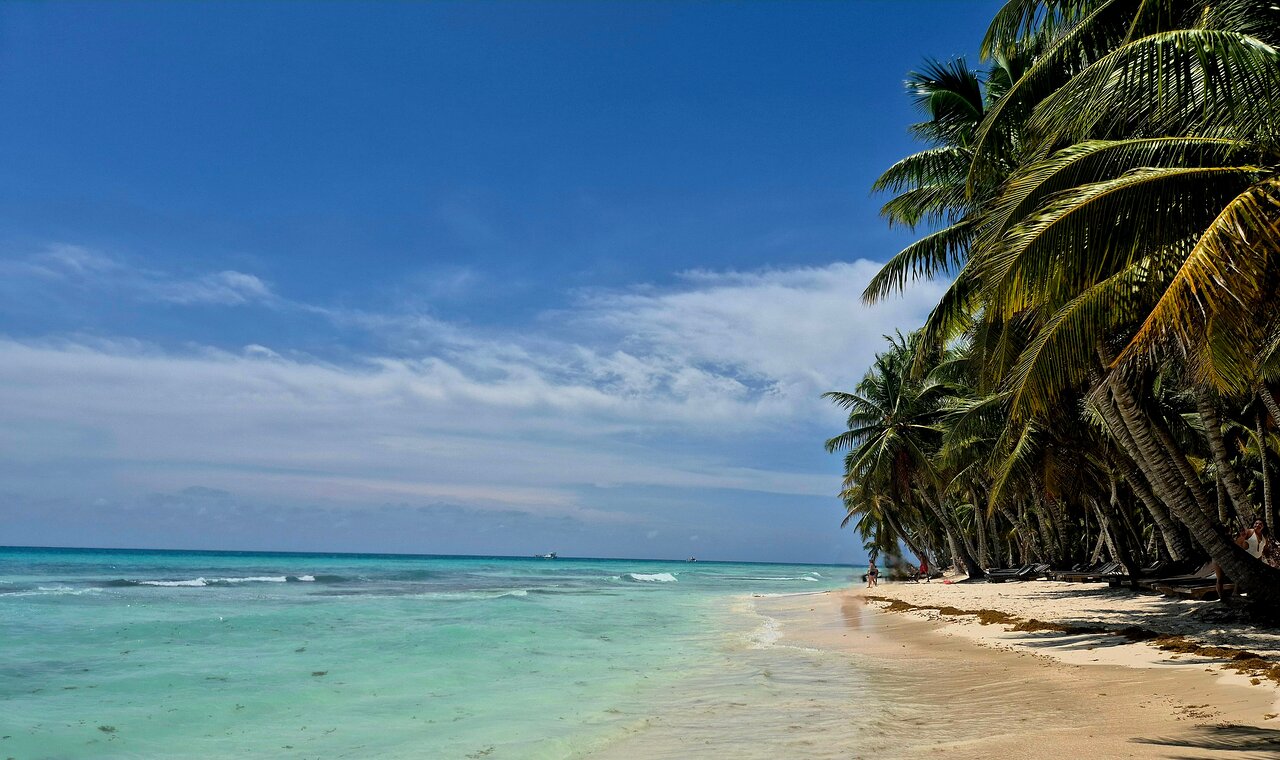
Different beaches can therefore experience different breaking patterns even under broadly similar offshore wave conditions.
8. What Influences Wave Conditions Around Saona Island?
Saona Island is part of the southeastern Dominican Republic and lies within the Caribbean region.
Its coastal wave environment can be influenced by several factors:
Wind direction and strength: Local and regional winds influence the direction and energy of surface waves.
Regional weather systems: Storms and changing atmospheric conditions can generate waves that travel toward the island.
Coastal orientation: Beaches facing different directions may experience different incoming wave conditions.
Water depth: The underwater shape of the seabed affects shoaling, refraction and breaking.
Reefs and other underwater features: Where present, submerged structures can alter wave energy and nearshore conditions.
Seasonal variability: Wind and weather patterns can change throughout the year.
These are general physical factors, not a claim that a particular wave height, direction or seasonal pattern has been measured at a specific Saona Island beach. Reliable local conclusions require observations or measurements from the relevant coastal location.
9. How Do Waves Affect Beaches and Marine Habitats?
Wave action is an important part of coastal environments.
Beach sediment movement
Waves can move sand and other loose particles along the shoreline and across the nearshore seabed.
The direction and amount of sediment movement depend on wave approach, water depth, sediment characteristics and local coastal geometry.
Coastal habitat conditions
Wave exposure can influence the physical conditions experienced by coastal organisms.
Some organisms are adapted to strong water movement, while others are more commonly associated with sheltered environments.
Water mixing
Wave action can contribute to mixing in the upper water column. This helps exchange heat, gases and suspended materials between different parts of the surface ocean.
Reef and seagrass environments
Where coral reefs or seagrass habitats occur, wave conditions can influence water movement, sediment suspension and the physical environment around these ecosystems.
The effects depend on local habitat structure and the intensity and frequency of wave exposure.
10. How Do Scientists Measure Ocean Waves?
Wave measurements are important for coastal engineering, navigation, environmental research and marine forecasting.
Scientists use several methods.
Wave buoys
Wave buoys measure surface motion and provide information about wave height, period and direction.
Some instruments also collect meteorological information.
Pressure sensors
Sensors placed underwater can record pressure fluctuations associated with passing waves.
These observations can be used to estimate wave characteristics.
Coastal radar
Specialized radar systems can monitor surface conditions over broader areas and help researchers study wave patterns.
Satellite observations
Satellite instruments can provide regional information about ocean surface conditions. Satellite altimetry is one method used to estimate significant wave height over large areas.
Visual observations
Trained observers can record breaking-wave patterns, approximate wave direction and shoreline conditions. Visual observations are useful but are less precise than calibrated instruments.
11. What Is Significant Wave Height?
Ocean waves occur in groups and vary in height. Scientists therefore use statistical measurements rather than describing the sea with a single individual wave.
Significant wave height is commonly defined as the average height of the highest one-third of waves in a measurement period.
It is often represented as Hs.
This measurement is widely used in ocean forecasting and marine engineering.
It should not be confused with the height of the largest individual wave. Some individual waves can be considerably higher than the significant wave height.
12. Why Is Wave Science Important for Boat Trips?
Boat operators and marine authorities consider sea conditions when assessing whether a journey is suitable.
Wave height is only one part of the assessment. Wave period, direction, wind, currents, visibility and vessel characteristics can also matter.
Short, steep waves may create a different experience from longer-period waves of similar height.
For visitors planning a boat trip to Saona Island, useful precautions include:
- Follow the operator's instructions.
- Pay attention to weather and sea-condition updates.
- Use the safety equipment provided.
- Keep a secure position while the vessel is moving.
- Avoid entering the water when the operator or responsible authority advises against it.
- Do not assume that calm conditions at one beach represent conditions along the entire route.
A beautiful coastal setting does not guarantee calm water throughout the day.
13. How Can Visitors Observe Waves Responsibly?
Wave observation can make a visit to Saona Island more educational.
Visitors can notice how waves approach the beach, where they break, how their patterns change around coastal features and whether different shoreline sections experience different exposure.
Responsible observation includes:
- Watching wave conditions from a safe distance.
- Avoiding restricted or unstable coastal areas.
- Following instructions from guides and local authorities.
- Never standing on fragile reef structures.
- Avoiding disturbance to marine organisms.
- Keeping plastic and other waste away from the shoreline.
Wave patterns are natural, but human activities can increase coastal pressure. Respectful tourism helps protect the environments that make the island valuable.
14. Climate Change and Future Wave Conditions
Climate change can influence ocean and coastal processes through changes in sea level, atmospheric circulation and storm characteristics.
However, changes in wave climate are not identical everywhere.
Some regions may experience changes in average wave conditions, while others may experience changes in extreme events or seasonal patterns.
Rising sea levels can also change how waves interact with shorelines and coastal structures.
Understanding future conditions requires long-term observations, numerical models and careful regional analysis.
It would be inaccurate to attribute a particular wave trend at Saona Island to climate change without appropriate local evidence.
15. Frequently Asked Questions
Are waves around Saona Island always calm?
No. Wave conditions vary with wind, weather, regional wave systems, coastal orientation and underwater geography. Conditions should be checked before travelling by boat or entering the water.
What creates most ordinary ocean surface waves?
Most everyday surface waves are generated by wind transferring energy to the ocean surface.
Do ocean waves move water or energy?
Waves primarily transport energy. Water particles move in orbital patterns, although currents and other processes can also transport water.
What is the difference between wave height and wavelength?
Wave height is the vertical distance between a crest and trough. Wavelength is the horizontal distance between successive crests or troughs.
Why do waves become taller near a beach?
Shoaling can reduce wave speed and wavelength as water becomes shallower. Under suitable conditions, wave height increases before the wave breaks.
What is wave refraction?
Wave refraction is the bending of waves caused by changes in their speed along a wave crest, often as different sections enter shallow water.
Can waves affect coral reefs?
Yes. Wave action can influence water movement, sediment suspension and physical exposure around reef habitats. The effect depends on local conditions and reef structure.
How can scientists measure wave height?
Scientists use wave buoys, pressure sensors, radar, satellite observations and other measurement systems.
Conclusion
Ocean waves are an essential part of the physical environment around Saona Island. They form through energy transfer from wind, travel across the sea, interact with the seabed and change shape as they approach the coast.
Concepts such as wavelength, wave period, shoaling, refraction, diffraction and breaking help explain why different coastal locations can experience different wave conditions.
For visitors, understanding wave mechanics provides a deeper appreciation of the sea and reinforces the importance of responsible coastal exploration. For researchers and coastal professionals, wave observations support safer marine activities and better understanding of changing coastal environments.
Saona Island's coastline is not just a scenic destination. It is also a place where the physics of the ocean can be observed through the movement of waves.

Local explorer & expert guide in Airbnb Dominicana.